Originally posted in March 2023, and then updated in July 2026 to reflect B Lab’s new global standards and Brand Book.
You see it on the supermarket shelves, on the runway and behind the scenes helping you build a brand, a life, a business, a home to be proud of. But what does being a B Corp really mean?
The B Corp logo is the mark of a company that has been independently verified to go beyond business as usual and meet verified standards of social and environmental performance, accountability and transparency. It’s a company certification, not a product one — so whenever you see it, it’s telling you something about the business behind the brand, not just the item you are holding.
It’s a badge imbued with meaning and purpose; one that gets earned through countless hours of deliberate, concerted action for a better world. And with over 11,000 Certified B Corporations™ globally, spanning more than 100 countries and 160 industries, it’s more visible than ever before. But more than a visible mark, it’s a movement of businesses making their mark on the world.
Here are five things you can know for sure when you see the ‘B’ out in the world.
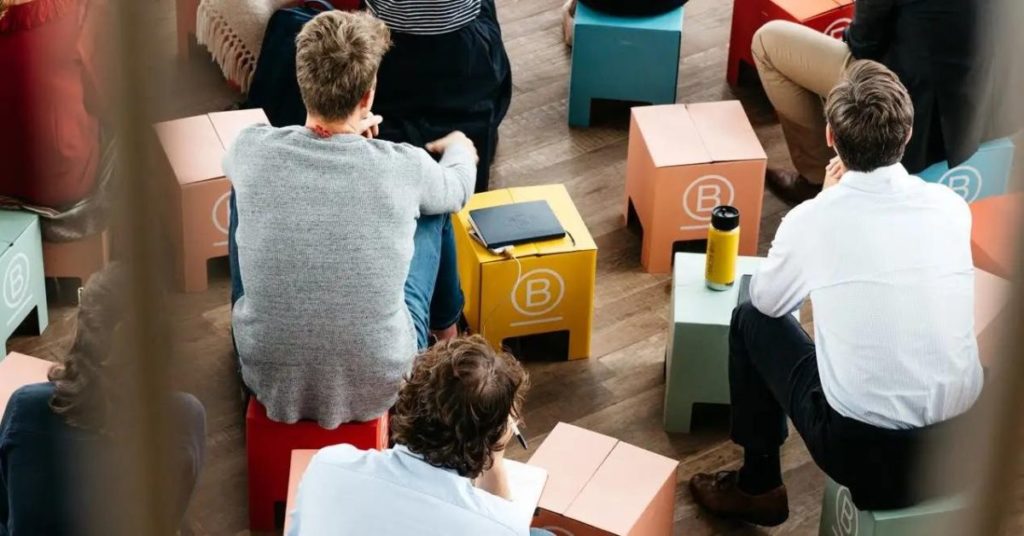
1. This company exists to benefit everyone, not just shareholders
Let’s start at the beginning, and by beginning we mean: what the ‘B’ stands for. The B in B Corp stands for ‘benefit’ — for people and the planet, not just shareholders. Certified B Corporations (or B Corps) are companies verified as meeting standards for social and environmental performance, transparency and accountability.
This is known as stakeholder governance, and it means a company distinctly prioritises everyone who has an interest, or a ‘stake’, in its performance and outcomes. That means people (workers, customers, suppliers, investors, regulators), the community more broadly, and the environment are all on an equal footing with profit.
Operating a business with more than profit in mind is a fundamental part of being a B Corp. B Corps are for-profit businesses; they exist to make money. It’s just that they don’t only exist to make money. Care for people and the planet must also be taken into account.
Under B Lab’s new global standards (version 2, or V2), Purpose & Stakeholder Governance is called out as one of seven Impact Topics every B Corp must act on. In practice, this means B Corps certifying under the new standards are required to establish a public purpose that drives meaningful positive impact, put a stakeholder governance policy in place, and have their highest governing body formally monitor their purpose and impact.
2. This company is verified, and held to it, again and again
If there’s one thing the world does not need more of, it’s empty promises and hollow commitments. Instead, we need more companies that are actually doing the good things they say they’re doing, and who are prepared to be transparent about it.
B Corps gain certification from B Lab™, the non-profit network behind the movement, which works to change the behaviour, culture and structural underpinnings of capitalism. Historically, this has been assessed through the B Impact Assessment (BIA), a standardised tool tailored to each company depending on its size, industry and location, with certification requiring a score of 80 or more out of 200.
B Lab has since rolled out its most significant evolution of the standards to date. Companies certifying under the new B Lab Standards (V2) no longer chase a single cumulative score. Instead, every B Corp must meet a set of Foundation Requirements — being legally incorporated and operating for at least 12 months, adopting the B Corp Legal Requirement, signing the Declaration of Interdependence, and completing a risk assessment — plus minimum requirements across the seven Impact Topics of Purpose & Stakeholder Governance, Climate Action, Human Rights, Fair Work, Environmental Stewardship & Circularity, Justice, Equity, Diversity & Inclusion, and Government Affairs & Collective Action. Certification decisions are now made by independent third-party certifiers rather than B Lab itself, adding a further layer of impartiality.
Earning the B Corp badge is just the start of the journey. Under the legacy standards (version 1.6), businesses recertified every three years, or after a Change of Control or Initial Public Offering. Under the new standards, that same spirit of continuous improvement is baked in even more tightly, with businesses required to show real progress against milestone requirements at the three- and five-year mark to retain their certification. ‘Impact’ has never been a destination to be reached or a box to be ticked, and that’s more true than ever.
3. B Corps come in every shape and size
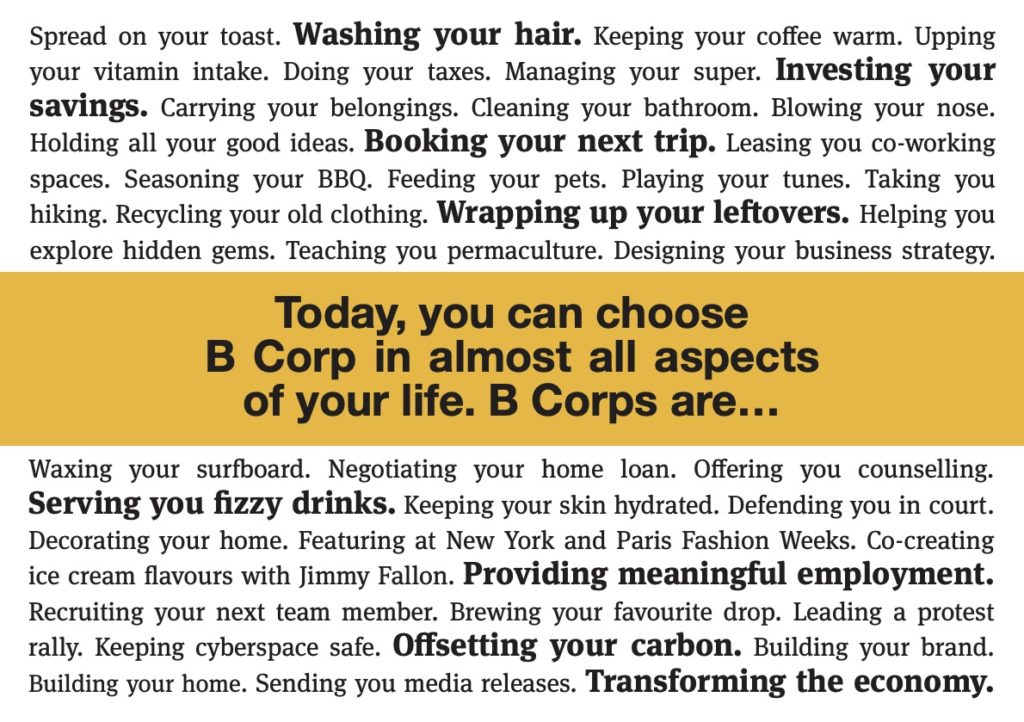
B Corps make products and offer services that we use all day, every day.
Spanning over 100 countries and 160 industries, B Corps come in every shape and size. Some are publicly traded, others aren’t. They have to have been in business for at least a year, and most are small to medium-sized businesses, with a handful of multinationals too, who have several enhanced requirements to meet under the new standards. There are sole traders who are certified, and there’s no minimum size requirement. There’s room for big and small under the B Corp umbrella.
Some industries remain ineligible for certification: fossil fuel production, gambling, pornography, prisons and detention centres, tobacco, and weapons. You can find out more about the movement’s positions on controversial issues and industries.
While B Corps may be as diverse as eco-friendly toilet paper and a superannuation fund, what they all have in common is that they’re companies who aren’t just talking about having a positive impact — they’re making sure their impact is tangible, measurable and transparent.
4. They actively practise radical transparency
If you want to conduct your business behind closed doors, do as you please and avoid being held accountable for your actions, no matter how destructive they may be, then becoming a B Corp is probably not for you.
It’s often said that one of the hallmarks of the B Corp movement is its commitment to radical transparency — radical in the sense that unethical, unjust and exploitative behaviour has been allowed to proliferate under capitalist systems for decades, and radical in the belief that a key way to transform the economy is to bring business practice out of the shadows and into the light.
All Certified B Corporations must share their impact performance on a public profile in the B Corp directory and publish an annual report on their social and environmental impact, covering things like supply chains, carbon footprints and aspects of financial reporting such as executive compensation. Under the new standards, this commitment to openness has been strengthened further: larger B Corps must now make public declarations of their tax policy, and all B Corps must have a public policy on responsible lobbying and publicly share their lobbying positions and political contributions each fiscal year.
By emphasising openness, honesty and accountability in every aspect of a company’s operations, B Corps are creating a more trust-driven, accountable and responsible business culture that is a far cry from the business as usual we’ve come to expect.

5. They are committed to benefitting people and the planet
B Corps based in Australia and Aotearoa represent AUD $27.6 billion in the local economy — B Corps are living proof that doing good is good for business. Compared with ordinary businesses using the B Impact tool, B Corps in our region are:
- 7.8 times more likely to have publicly available measurable social or environmental indicators or outcomes
- 5.5 times more likely to have some practice for supply chain biodiversity improvement
- 2.3 times more likely to have ongoing formal due diligence and review procedures to protect human rights in their operations and supply chain
- 4.2 times more likely to explicitly acknowledge the rights of Indigenous peoples in their human rights policy
- 6995 B Corp employees are eligible for ownership plans (stock, options, or equivalents)
A quick word on the logo itself
The B Corp logo is distinct, and it sends a powerful signal to consumers. It’s only ever shown in black or white, never recoloured, rotated, skewed or used in place of a letter in a word. And under B Lab’s updated Brand Book, every use of the logo — on a website, on packaging, or in a video — now needs to point people back to bcorp.com, so consumers can look up exactly what a company’s certification covers. It’s one more way the movement is making sure that when you see the ‘B’, you can trust what’s behind it.
From environmental sustainability to social justice and beyond, any time you see the B Corp logo, remember that this is a company designed to benefit people and the planet.
A company that cares about far more than just the bottom line. A company that voluntarily invites greater accountability, transparency and scrutiny, in order to lead the change that is needed. A company that prioritises people, planet and communities, beyond what’s expected or has been done in the past — one with positive impact woven into the very fabric of its being, and one that is committed to working alongside others to transform our economic system.

