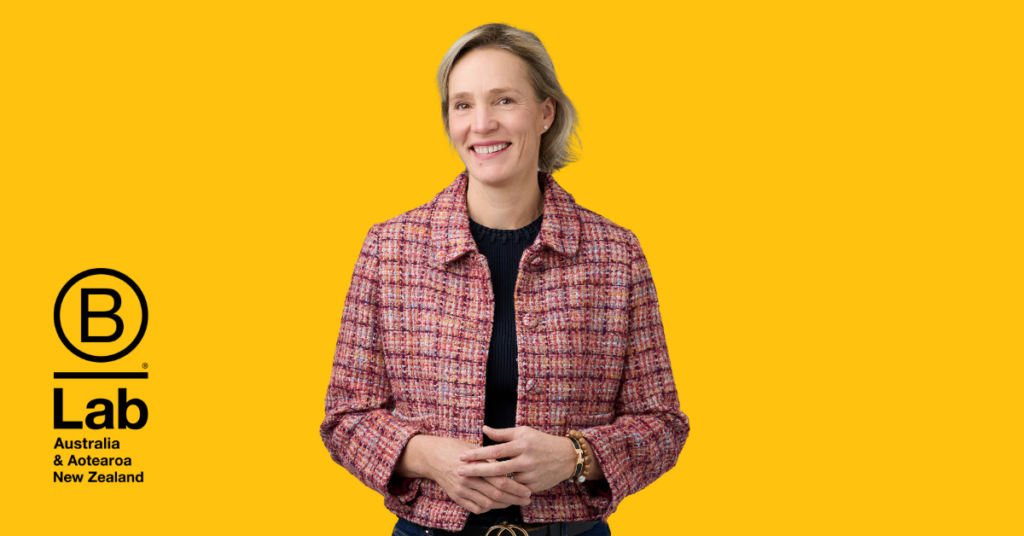
This year we marked 20 years of building the B Corp movement, and said a grateful farewell to Andrew Davies, whose seven years as our region’s CEO helped bring us here. Now we are looking ahead, and are excited to welcome Kate Healy as the Regional Director for Australia and Aotearoa New Zealand, part of a new global leadership structure. To introduce her to the B Corp community, our Director of Communications & Engagement, Angie, sat down with Kate to hear her early reflections.
Angie: Tell us about how you found yourself here at B Lab.
Kate: I found myself here from a fortuitous LinkedIn post. I read through the criteria and thought that’s just what I’m looking for: a role that brings together the skills that I’ve built over 30 years of working; connects Australia and Aotearoa New Zealand, both places that I’ve lived in for a long time and have a deep sense of belonging to; and working with an organisation that has a strong sense of purpose and mission.
And what did you know about B Corps before you took on this role?
When I was studying an MBA back about 10 years ago, we were looking at theories behind stakeholder governance. B Corps were just emerging in Australia at that point in time. A couple of the case studies we looked at involved B Corps, and what struck me even then was that stakeholder governance wasn’t a nice-to-have, it was a smarter, more resilient way to run a business.
And on a more personal connection, my husband is a Director at Bank Australia, so he also has that link with a real-life B Corp!
As a leader at B Lab, you’re providing leadership for not just our growing team, but also for the B Corp community. What do you think success looks like in your role for both stakeholder groups?
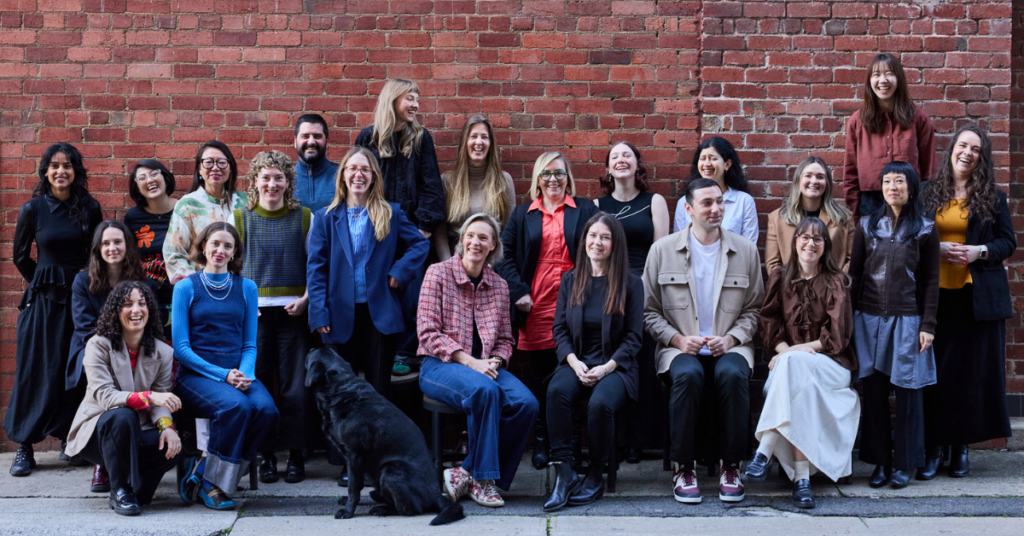
For the team, my focus is to support them through another year of change. Not only are we rolling out new standards and certification processes, but we’re also evolving our governance structure and local leadership. With all the newness, my job is to make sure the team feels supported throughout. If in a year’s time everybody is still smiling the way they were on my first day, then I’ll be happy and I think we’ll have achieved that.
In terms of B Corps and our wider business community, success would be for them to have confidence in me and what I represent, but also to continue to have confidence in B Lab and the direction of our movement. We’re excited to embrace the new standards and the rigour that comes with them. Success is the community feeling confident we’re raising the bar for the right reasons. Credible impact should be rigorous, and the new standards protect the value of the work they’ve already put in.
What do you see for the future?
I’d love to see us grow, but grow in a way where being a B Corp continues to really mean something. We want people to see just how valuable the certification process is for making better businesses. But I don’t think our role stops at certification. There’s real appetite to change the rules of business, things like directors’ duties and stakeholder governance, so that doing right by people and the planet is just part of how business works. That’s where I’d love to see us lead, and be a voice government and industry turn to, and generate some real collective action along the way.
Let’s talk a little bit about the experiences that you’ve had. What do you think your experience can bring to this work?
The first act of my career was as a lawyer, so I spent about 15 years working in law firms in Australia and Aotearoa. From that work, I bring a very technical, attention-to-detail focus that sits well with the certification and technical requirements of B Corp Certification. This helps me deeply understand the standards and how they apply, how they sit alongside other regulations and legislation, and their interoperability. It’s also why I’m excited to get stuck into things like New Zealand’s Law Commission review of directors’ duties. That’s exactly the intersection of law, governance, and impact where I think we can be a credible voice.
In my second act, I worked closely with Māori and Aboriginal and Torres Strait Islander organisations and communities across both countries. I also worked with large corporates and governments on bringing to life the economic prosperity and opportunity that First Nations organisations and communities seek. I have a fairly strong understanding of the cultural lens we all need to apply when working with First Nations organisations, and the opportunities this sector brings.
Part of our local strategy is demonstrating how essential Indigenous Peoples’ leadership, partnership, and self-determination are to our vision, so we are so excited to see how your experience lends itself to this work.
The community that we have in Australia and Aotearoa New Zealand now includes over 800 B Corps from around 100 industries. What excites you most about working with them?
I can’t wait to get out there — to get to know them and understand their businesses. I really like one-on-one connection and understanding what people are doing and what motivates them. Seeing the sheer breadth of the community helps me understand that this is a real movement, so there’s power in connecting people. So I’m most interested in what happens when B Corps learn from each other; a food manufacturer and a law firm and a shoe company all working out what higher standards look like in their world.
One thing we’re curious about is your leadership approach. Leadership generally has to be adaptive, especially in systems change. What’s something that keeps you grounded when the world’s so quickly changing around us?
Tough question, Angie. I feel like my life outside of the office keeps me quite well grounded. I have a couple of kids and a couple of dogs, who get me outside and moving. I mentioned before my husband — we spend a lot of time together outside too. That connection with nature and just stopping to breathe and think is really helpful. At work, I make space for connections and to get to know people as individuals. The problems we’re trying to solve can feel so complex, but ultimately we’re just dealing with individuals and people. If we can break it down into that bite-sized piece of an individual relationship or a conversation, then it becomes less daunting.
That’s a perfect way to bring us to our last question: what do you think the world needs more of right now?
I think the world needs more compassion for ourselves and for each other. And to be compassionate, we need to take the time to understand other people’s perspectives and where they’re coming from. This makes it easier to sit with people we don’t agree with — the conversation changes when we bring compassion to the table. And it gives us patience, which is really necessary when you’re working through change.
| Join us: Looking back to look forward 24 September | 1pm AEST, 3pm NZST | online Join us for a special online community gathering as we welcome Kate as our new Regional Director for Australia & Aotearoa New Zealand, share highlights from our upcoming FY26 Impact Report, and preview our local plans for the next 12 months. |

