This B Corp Month, we’re on a mission to bust myths and share what B Corps really are, and why they matter. Whether you’ve seen the ‘B’ on your favourite product, wondered what ‘Certified B Corp’ really means, or think you know the answer — this blog is for you.
“B” stands for Benefit: for workers, communities, customers, and the environment, alongside shareholders.
That principle is not a slogan. It must become part of B Corps’ ways of working, requiring leaders to consider social and environmental impacts as well as financial return.
B Corp is about balancing purpose and profit, recognising that long-term business success depends on the health of the systems a business participates in.
Importantly, the encircled “B” was never intended as a shortcut for trust; it goes far beyond product packaging and customer decision-making.
Myth: B Corp is just a marketing tool
Truth: B Corp Certification is not a ‘tick’; it measures how a business operates.
Once a business decides it wants to become part of the B Corp movement, certification doesn’t happen automatically, and it isn’t self-declared.
To become a B Corp:
- To certify, companies must achieve a certain level of performance, and formally change their governing documents to embed consideration of workers, communities and the environment.
- Businesses begin by completing a self-assessment, answering questions based on their size and industry.
- Their responses must then be backed by evidence, which is reviewed and verified. Under B Lab’s new Standards V2, companies are independently verified by third-party auditors.
This model matters because it sets a consistent bar. Certification cannot be purchased, and intent alone is not enough; companies must demonstrate that they ‘walk the talk’.
It also cannot be treated as a one-time milestone. B Corps will be audited at regular intervals depending on their size and industry, and the standards themselves evolve, meaning expectations rise over time. It is not set-and-forget: businesses must continue to improve at each certification.
Ultimately, the B Corp logo may help businesses communicate their values to customers.
But the certification exists to create accountability, not marketing opportunities — and to ensure that balancing purpose and profit is measured, verified and revisited over time.
Myth: B Corp is just a sustainability badge
Truth: Sustainability matters, but B Corp Certification extends well beyond environmental initiatives.
For many businesses, responsibility begins with environmental action: reducing emissions, transitioning to renewable energy, improving materials and waste systems. These steps are often the most visible, and they are important.
But environmental performance alone doesn’t capture the full impact of a business.
B Corp Certification is not a sustainability certification: it is an integrated assessment of a business’s environmental, social, and governance practices. It considers treatment of workers, customers, environment, and community, recognising the interconnected nature of these impact areas.
Under the B Lab’s new Standards V2, starting in 2026, companies are required to achieve a minimum standard across each of the following areas:
- Climate action
- Purpose and stakeholder governance
- Environmental stewardship and circularity
- Fair work
- Justice, equity, diversity and inclusion (JEDI)
- Human rights
- Government affairs and collective action (GACA)
As overlapping crises become more destructive, the urgency to address them grows. The new standards, which also include an extra level of verification by a third party, ensure that B Corps continue to be part of a meaningful global movement working to benefit people and the planet.
Myth: B Corps are meant to be perfect businesses
Truth: Leadership looks like accountability and continuous improvement — not perfection.
Certification doesn’t mean that a company has solved every challenge or eliminated every issue within its operations. Instead, it communicates that the business has met credible, verified standards and is committed to improving over time.
Over recent years, as the movement has grown, some people have questioned how large companies, or those in complex industries, could possibly have achieved B Corp Certification.
The truth is, we aren’t saying these companies are perfect — nor are they. Instead, we are welcoming their commitment to improving, and being transparent along the way.
B Corps have met our standards, and will need to recertify on standards that continue to set a higher bar. The certification of imperfect businesses means we can begin to ‘shift the baseline’ in a positive direction.
This means things that are viewed as ‘normal’ or ‘unavoidable’ within certain industries — whether excessive waste, worker poverty or irresponsible lobbying — may over time come to be widely accepted as outdated and unnecessary.
“If we curate a small club of perfect businesses, we miss opportunities to look at the bigger picture, including companies with big footprints, who can create change at the scale needed to transform our economic system,” says Kira Day, Head of Communications and Advocacy at B Lab AANZ.
Leadership, within the B Corp framework, is less about projecting flawlessness and more about demonstrating transparency, discipline and a willingness to improve in public.
What this means for Australia and Aotearoa New Zealand
Across Australia and Aotearoa New Zealand, the B Corp community continues to grow — not as a collection of perfect companies, but as a network of businesses holding themselves to shared standards with external verification.
As of March 2026, there are 777 B Corps in the region (and counting)! If you explore the B Corp directory, you’ll find you can buy products or services from B Corps in almost all areas of your life. (Tip: filter by ‘country’ to find businesses closest to you.)
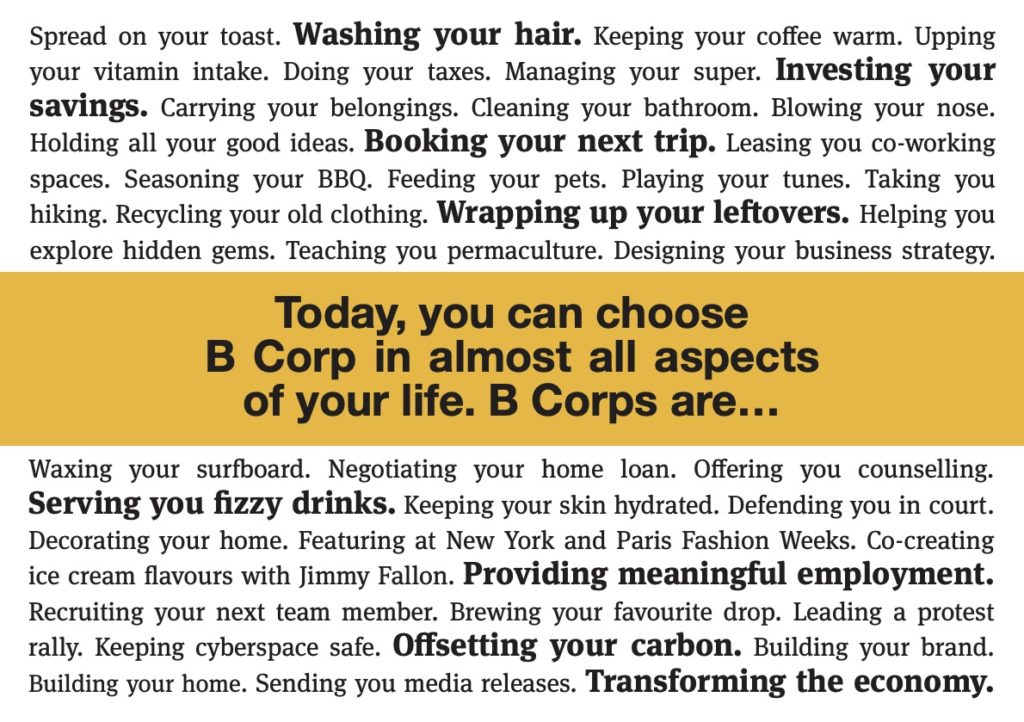
Many of these companies are leading in their industries. In the past twelve months, this has looked like Intrepid Travel becoming part of a ‘Safer Tourism’ pledge, Bank Australia expanding impact lending for First Nations Traditional Owners to buy back Country, Kowtowrecycling its garments into nutrient-rich biochar, and many more stories of commitment to change.
The strength of the movement doesn’t lie in signalling virtue. It lies in creating a shared understanding of transparency and accountability — one that recognises complexity and supports measurable improvement. Responsibility is not a finish line that companies cross once and for all. It is ongoing work that shapes a business’s practices over time.
As the movement continues to grow, more opportunities for collective action will emerge: businesses standing and working together, to push for change, innovate and educate.
Meaningful change begins not with perfection, but with businesses willing to be measured — and to keep improving — together.

