You click the link looking for signs. The em dashes. The staccato sentences. The suspiciously balanced ‘it’s not x, it’s y’ phrasing, before you declare: “aha, I knew it”. And perhaps, that instinct says everything about the moment we are living through. Trust is teetering. Truth feels increasingly up for grabs. And the breakneck pace of change has us all in a spin. Oh no, the ‘rule of three’; another obvious tell.
But the use of AI in the workplace has already moved lightyears beyond a little help typing up meeting notes or piecing together an article. What we are now grappling with is something far bigger and altogether more challenging.
What does ethical leadership look like in the AI era?
How do we lead teams through a transition moving faster than our structures, governance models, and nervous systems were designed for?
What does accountability look like when there are fewer humans in the loop and growing networks of agents making decisions for which they can’t be held responsible?
These questions and more provided the backdrop for this year’s Wisdom & Action Forum ‘Trust in the age of AI’, hosted by Small Giants Academy on beautiful Wurundjeri Country in Melbourne (Naarm).
In a session aptly titled ‘Leading Organisations Through the AI Transition’, B Lab Australia and Aotearoa New Zealand (AANZ) CEO Andrew Davies joined Culture Amp founder and CEO Didier Elzinga, AI strategy and transformation executive Orla Glynn, and world-first ‘neuro futurist’ and Director of the Future Minds Lab at UNSW Professor Joel Pearson, to unpack the tensions rapidly emerging for leaders and boards as AI reshapes our work and our world.
Rather than searching for easy answers or falling into familiar binaries of optimism or doom, panellists explored five central paradoxes leaders are being asked to hold right now. Because while agentic systems and Large Language Models (LLMs) may define the technological shift underway, what many organisations are actually experiencing is something far more human: a stress test in capacity and adaptability, alongside a profound recasting of the role of ‘leader’ itself. Now is as good a time as any to ask what kind of future we are building.
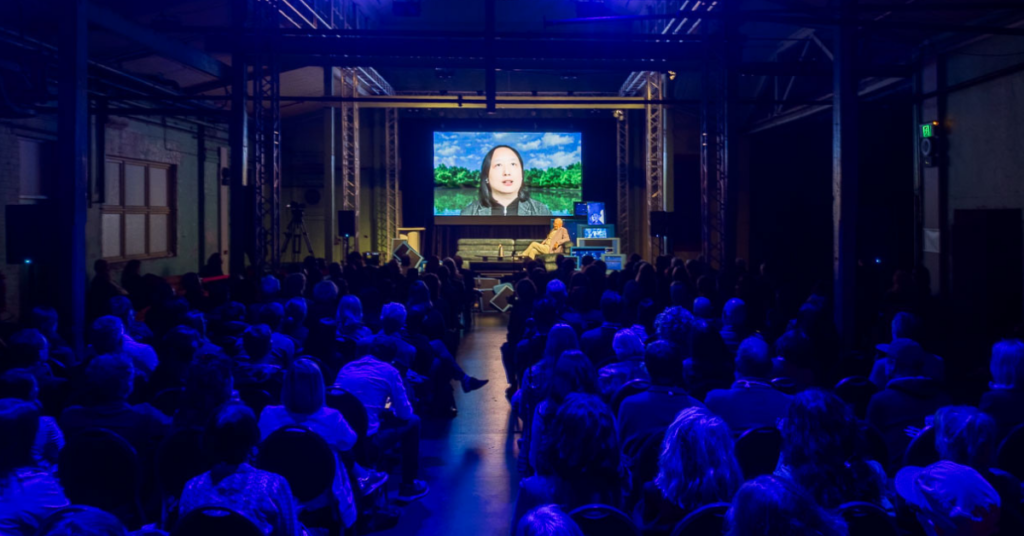
Image: Peter Casamento
Speed vs judgement
The pressure organisations and boards are feeling to move quickly on AI is immense. For B Lab AANZ CEO Andrew Davies, the challenge is not only the change itself, but the speed of it. And yet, while organisations race to adopt AI, many are still operating inside systems and structures designed for a slower, more centralised flow of decision making. Fewer still have stopped to ask what they are actually moving faster towards.
Orla Glynn is an AI strategist who works with CEOs and leadership teams on the questions most organisations are avoiding. She is seeing too many organisations still treating AI as “a tool to bolt on” to existing systems, rather than recognising how fundamentally it redistributes information, authority and decision making across organisations.
“We have a situation where you have the need to move fast because the market is demanding you to go fast. But… at no point has leadership stepped back and said: ‘have we actually designed or redesigned our organisation for what it means in the AI era?’”
— Orla Glynn
Challenging the assumption that integrating AI is primarily a technological imperative, Glynn argues instead that it is actually a much deeper structural redesign challenge. That if we remain overly focused on efficiency and cost reduction, we avoid the harder and more strategic question: what does this organisation become because of AI?
The tension being, organisations are being rewarded for acceleration at the exact moment they most need judgement, reflection and restraint. And while the technology is evolving exponentially, human cognitive capacity, organisational structures and governance systems are struggling to keep pace.
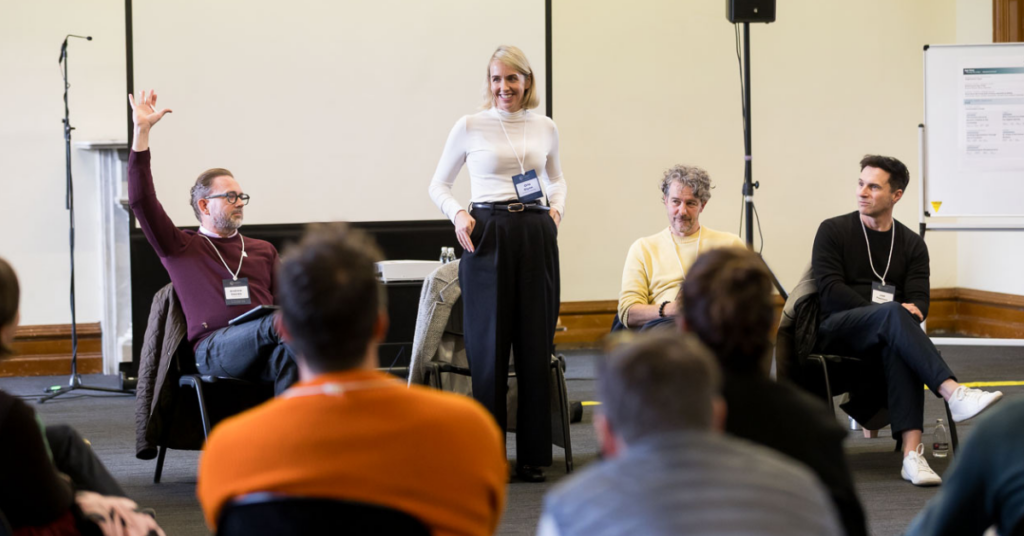
Image: Peter Casamento
Trust vs accountability
Agentic systems are already shaping decisions across workplaces, often faster than governance structures can keep up. Yet while organisations may delegate tasks or analysis to AI, accountability still lands squarely on humans. So what does responsible governance look like when leaders and boards are required to oversee technologies they do not fully understand?
There is a significant gap starting to emerge in AI literacy at the leadership and board level, and many organisations are placing growing trust in external vendors and systems without the internal capability to properly interrogate risk or manage accountability. That challenge becomes even more complicated when we consider the nature of AI systems themselves.
Chair and founder of market-leading employee experience platform and Certified B Corporation Culture Amp, Didier Elzinga, pointed out that AI systems are still far from deterministic. They do not reliably produce the same output every time, which fundamentally challenges traditional ideas around oversight, consistency and control.
Rather, business leaders and boards are now being asked to place trust in systems that are probabilistic, opaque and constantly evolving, while still carrying full responsibility for the outcomes those systems produce.
“Almost every company is looking at their core values right now and going, ‘do we have to change some of them to lean into this new world of work?’ The question that a lot of them aren’t asking is, ‘who are those values for?’ Because they’re no longer just for humans.”
— Didier Elzinga, Culture Amp
Panellists challenged the growing assumption that AI will somehow deliver perfectly objective decision making. It won’t. But then again, humans are hardly flawless decision makers ourselves. If AI can help reduce some of those fallibilities and, in some contexts, lead to better decisions when paired with human oversight and expertise, is that a good thing? Neuroscientist and world-first ‘neuro-futurist’ Joel Pearson thinks so, while acknowledging that this is also where the ethical tension deepens.
“AI can overcome a lot of those fallacies or problems with human decision making. And so I think soon, whether you’re a medical doctor, a judge or a politician, it’ll probably be illegal to make decisions that are consequential without the aid of AI, because together, you can sort of get the best of both worlds.”
— Joel Pearson, Future Minds Lab
Pearson also warned that, as AI becomes more embedded in consequential decision making, there is a risk that humans begin distancing themselves from the moral culpability of those decisions simply because an AI system was involved in making them. The danger, it follows, is not only that AI replaces intuition or human decision making, but that responsibility starts to feel more diffuse and easier to rationalise away.
We cannot outsource responsibility simply because we have outsourced the workflow. And perhaps that becomes one of the defining leadership inquiries of the AI era: not simply what these systems are capable of doing, but whether we are still willing to fully own the consequences of the decisions they help us make.
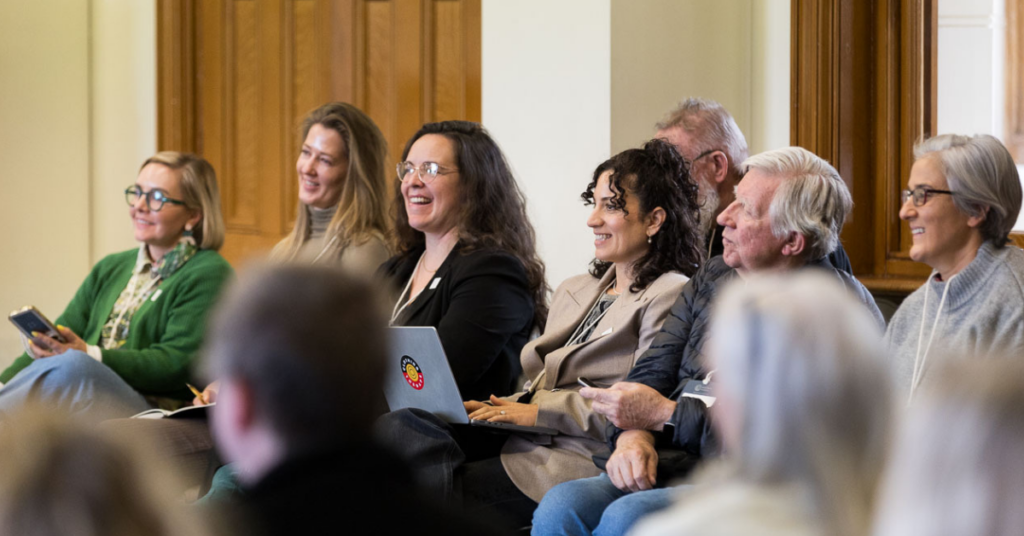
Image: Peter Casamento
Profit vs prosperity
AI is creating value at the firm level, but disrupting value distribution across broader systems. And while much of the current business conversation centres on productivity, efficiency and cost reduction—not to mention swathes of ‘AI redundancies’ already underway — the harder conversation we need to have is: what happens when the economic value generated by AI no longer flows through people, wages and communities in the same way?
For a movement whose theory of change rests on a fundamental recalibration of the purpose of profit in our economic system, these are far from peripheral concerns. Indeed, this paradox sits at the heart of stakeholder governance, fair work and responsible business leadership for both B Lab as a global network and the wider B Corp community.
So what does dignity and prosperity look like in an economy increasingly shaped by agents and distributed intelligence? What entirely new forms of value creation and collaboration can we expect? Where does the value flow? How do we tax that value? What obligations do we have to workers, communities and future generations during that transition?
For Culture Amp’s Didier Elzinga, cost cutting is the easiest and least imaginative application of AI technology:
“The easy thing to chase is the cost saving, because it’s the business case that writes itself. But that is, at best, an arbitrage. It lasts maybe a year, and then everybody else will do the same thing. So the question for every business is not, ‘how do you rip 30% of your cost out?’ The question is, ‘how do you build something that uses AI for great growth?’”
— Didier Elzinga, Culture Amp
The challenge for leaders, particularly within an ethical and purpose-driven framework, is ensuring the gains created through AI are shared in ways that strengthen people, communities and the planet, rather than concentrating and consolidating power and resources even further at the top of the chain.
As AI continues to reshape the economy, we must make a deliberate choice: whether we allow the future to become more extractive and unequal, and how we are going to demand one that’s more inclusive, distributed, equitable; an economy that truly benefits all.
Competition vs collective responsibility
One of the strongest themes throughout the session was how many of the opportunities and risks emerging around AI are both systemic and shared. Workforce wellbeing, surveillance, privacy, even AI brain fry — these are neither challenges individual organisations are facing, nor will be able to solve in isolation, particularly when competitive pressure is pushing entire industries in the same direction at once. Yet another declaration of our interdependence and more difficult questions for leaders.
What happens when ethical choices create commercial disadvantages?
What responsibility do organisations have to ensure workers and communities can meaningfully participate in the transition?
How do we prepare the next generation for a future that’s so uncertain, especially when many of the junior, entry-level and administrative roles that have traditionally acted as pathways into industries are now the first to go?
For Future Minds Lab’s Joel Pearson, one of the biggest gaps in navigating the transition right now is not technical capability, but rather our brain’s capacity to collectively process the rapidity and implications of change:
“We are in an uncertainty pandemic right now and a lot of people respond to that with anxiety. When AI comes into a business, they worry about the future of their job. What about their mortgage? And so there is a fundamental human support piece to navigating change that is more important now than basically anything else at any kind of scale.”
— Joel Pearson, Future Minds Lab
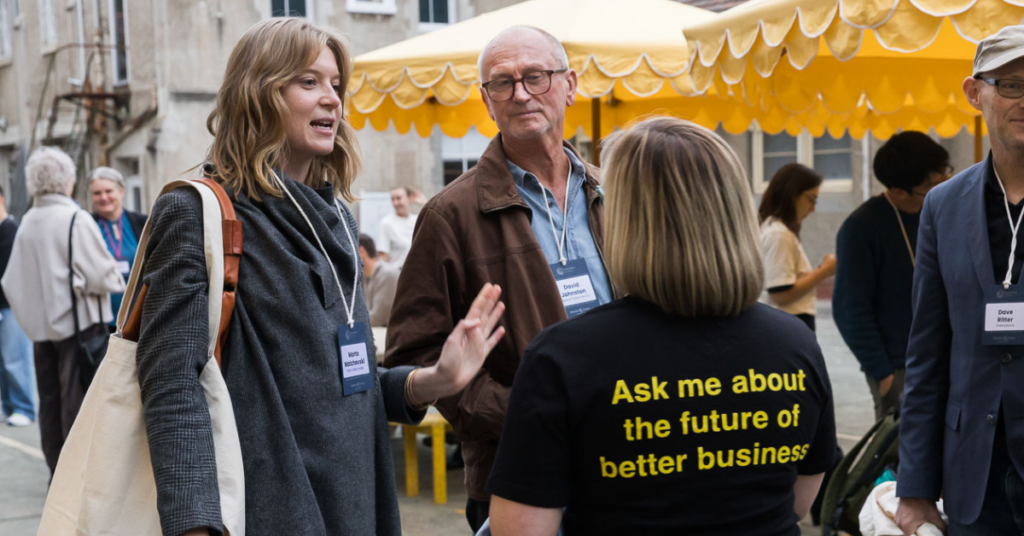
Amidst widespread stress and anxiety, Pearson spoke to the need for a different class of AI-specific change management models and frameworks, not just for businesses, but families and whole countries. He explained that while people might understand what AI is or what it’s not, we need more spaces to “socialise and verbalise that information”. More ways to share stories, what works and what terrifies us, as a way to help reduce our collective uncertainty.
Images: Peter Casamento
As leaders, we also need to be mindful of forcing a binary between ‘pro-AI’ as ‘anti-people’ and ‘pro-people’ as ‘anti-AI’. Instead, we need to create more space for collective sense-making and nuance. Not only policies and frameworks, but environments where people can build shared language, ask difficult questions, and process change together.
“We can’t have a conversation if everyone doesn’t understand. And so — I use these words internally — ‘I’m happy to have any conversation with you if you’re in the pool, but I can’t talk to you while you’re standing on the outside’, because we just don’t have the same language. And so I think the trick or the challenge that is on leaders is, how do we equip people to understand the space and give them opportunities to explore?”
— Didier Elzinga, Culture Amp
| Continuing the conversation Spaces like the Wisdom & Action Forum matter because they create room for something increasingly rare: thoughtful, values-led conversations about the future we are building together. For leaders looking to deepen their understanding of ethical leadership, systems change and navigating complexity in the age of AI, Small Giants Academy offers a range of programs and experiences designed to support exactly this kind of collective learning and reflection. Find out more and access discounted rates for B Corps ↗ |
Authority vs capacity
The ability to hold ambiguity, adapt under pressure, forge trust, and continue making decisions in systems that are becoming more complex, distributed and unpredictable by the day — this is the crux of modern leadership. Do we have the capacity to match?
The final paradox for discussion: what happens when the very leaders who are responsible for ushering teams through the AI transition are the same people whose authority, expertise and roles are being fundamentally challenged and reshaped by it?
Traditional leadership has long been built on expertise, authority, decisiveness, and having the answers. So what happens when information flows faster than hierarchies can process it? What happens when the people closest to the technology may not be the people with the most formal authority? And what does leadership look like when certainty itself becomes increasingly scarce?
For Pearson, one of the most important shifts leaders can make is adopting a beginner’s mindset and instead creating environments where information and learning can move more freely across organisations. For Glynn, the imperative is for leaders to focus on workforce transformation and readying themselves and their organisations for the complexity of what lies ahead.
“We keep asking whether organisations are ready for AI. A better question might be whether leaders have the capacity to navigate what AI is about to demand of them.”
– Orla Glynn
For Elzinga, honesty is best. “Organisations would be better placed to actually try and engage people and take them on the journey, and to be honest about the fact that they can’t give them the certainty they want,” he added. While it might be an awkward conversation to have, “to say anything other than that is actually lying”.
Perhaps the reimagined role of ‘leader’ is less about providing certainty and having all the answers, and instead a willingness to be transparent and involve teams in shaping what comes next.
No neat answers, but that’s the new normal
There is still so much we don’t know about what business and leadership will look like in the age of AI. What we do know is we need more leaders, guided by ethical frameworks and robust standards, prepared to wade into its murky waters and moral implications.
We also suspect the organisations best positioned to prosper through the transition may not be the ones that are moving the fastest. Instead, they are likely to be the ones building the capacity to navigate change and doing what they can to stay connected and human while the world around us continues to shift.
This discussion made clear that no organisation has fully figured this out yet. Leaders across every sector are navigating difficult trade-offs around governance, workforce transition, accountability, productivity, ethics and trust, often all at once and at high-speed.
Perhaps that is why the Māori whakataukī shared during the session felt so resonant: Kia whakatōmuri te haere whakamua — I walk backwards into the future with my eyes fixed on the past.
Our challenge as leaders is to slow down, at least occasionally, so we may carry forward the lessons and values that make progress worth pursuing in the first place.
What’s next
Have your say
How is your organisation approaching the AI transition? What guardrails, questions or practices are helping you navigate this moment more responsibly? Jump onto the B Corp community board and join the conversation ↗
Learn and grow
Explore Small Giants Academy’s range of programs and experiences focused on ethical leadership, systems change and navigating complexity in uncertain times ↗

