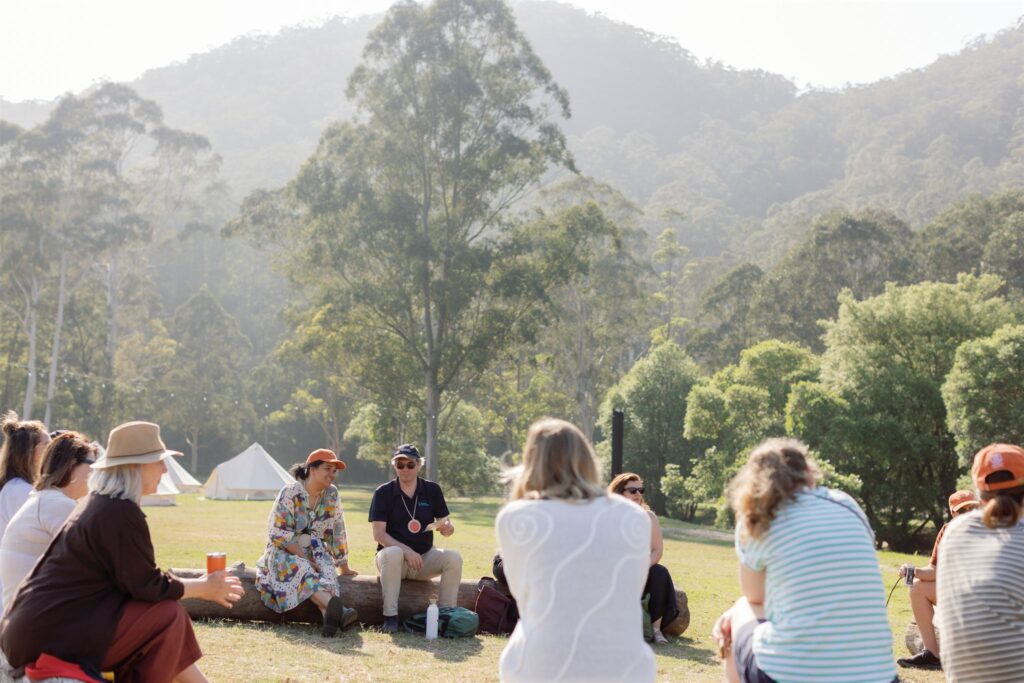
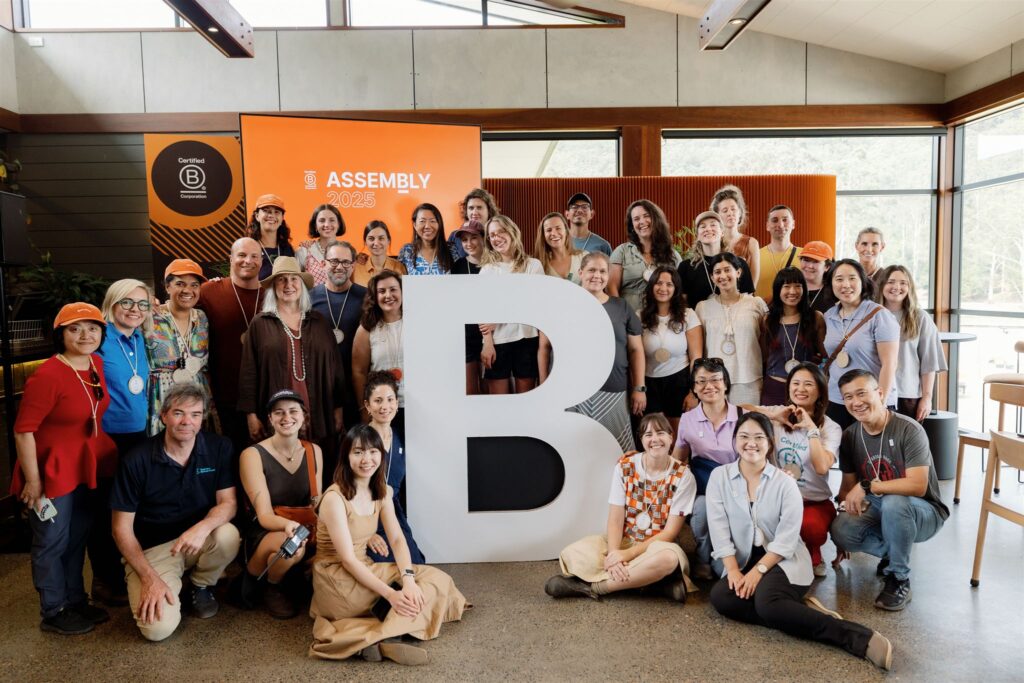
Bring together over 240 purpose-driven leaders under blazing skies, add a few flies, and what do you get? Assembly 2025 — three unforgettable days of community and connection on Darkinjung Country and an important reminder of the collective power and scalable impact of a movement determined to do business differently.
From a stirring opening ceremony to celebrations beside the hearth fire, there were moments of inspiration, imagination, provocation, healthy contention, and everything in between. As we’ve come to expect, Assembly 2025 was as far from ‘business as usual’ as it really gets. It was business unplugged. An ode to the truth that change rarely happens in air-conditioned boardrooms, but in places where the earth is close, the air is clear, and purpose can be felt in the body as much as the mind.
Yes, it was unseasonably hot. A keenly felt reminder of what’s at stake if we continue to overshoot planetary boundaries. Yes, glamping falls outside the typical confines of conference accommodation. And yes, taking days out of busy schedules can feel like a luxury. Yet, it was also everything we needed. Plus, there’s something to be said for the equalising effect of brushing your teeth next to fellow changemakers in your jammies.
However, if we had to ‘boil’ it down, there was one word that came to encapsulate the Assembly 2025 experience. A single syllable, both noun and verb; a reminder of what binds us together, in this moment, as a movement, and as human beings working hard to transform a global economic system. That word is care.
Care for Country. Care for each other. Care for the shoulders we stand on as we peer into our shared future. And care for a movement as diverse and rapidly changing as the world itself. Here’s how it went down in the Glenworth Valley and how you can continue to show up and meet the moment, long after the tents have been packed down.
Images: Elin Bandmann
Key insights (take what you need)
While we encourage you to move beyond the bite-size and soak up this longer reflection piece with curiosity and care, if you have only got a few minutes, click the header below to get where you want to go:
| Care for Country: A powerful welcome on Darkinjung land reminding us that every act of business takes place on someone’s Country — and that moving forward also means looking back with respect. Care for the experience: Highlights across a thoughtfully curated program designed to mirror First Nations’ wisdom and channel expertise across three key themes: Changing Climate, Shifting Systems, and Cracking Echo Chambers. Care for community: From Climate Cafés to mental laps around the fishbowl, we dug into the messy, meaningful work of bringing people together and why connection is the beating heart of systems change. Care for the past: Lessons from Aunty Bronwyn Penrith, Toi Iti, and Derryn Heilbuth on resistance, protest, and the enduring legacy of standing on the shoulders of giants. Care for our shared future: A glimpse of where we’re headed, and what’s needed from us, through the voices of young climate leaders Ruby Rodgers and Tishiko King. Care for the movement: Is it possible to create systems that care, or is that outsourcing the very work that makes us human? Echoing the words of B Lab Co-founder Andrew Kassoy’s last public address, we draw on the insights of Helen Paul-Smith, Alison Michalk, Dr Matt Beard, and Andrew Davies — a poignant reminder that change is best done in good company. Care for the moment: How to keep showing up intentionally, relationally, and imperfectly, as we move towards a more equitable, inclusive and regenerative future with clear eyes and open hearts. |
Images: Elin Bandmann
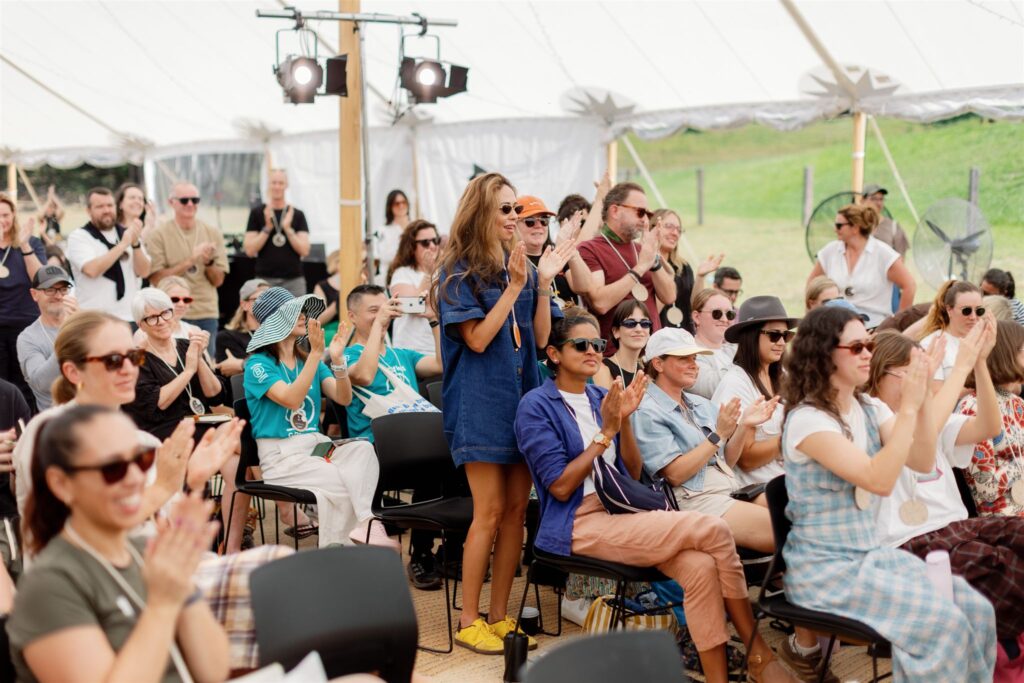
“A gathering like no other and one that reinforced why I care so deeply about this movement and the people in it. There was so much depth, variety and learning packed into every session.”
— Natalia Sawran-Smith, TalentWeb
Care for Country, as it cares for us
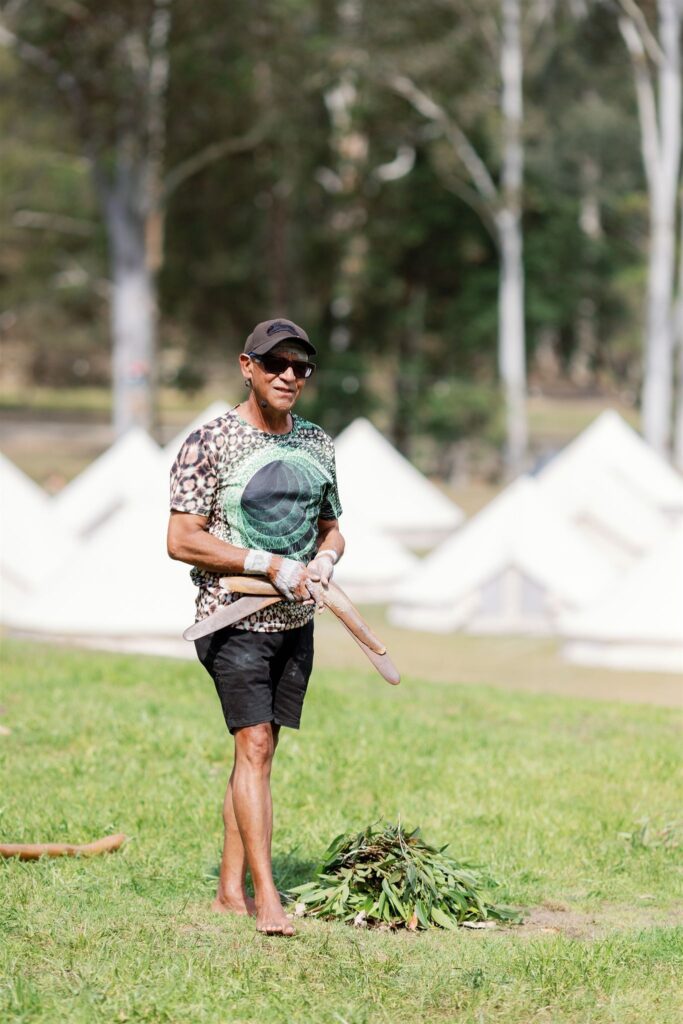
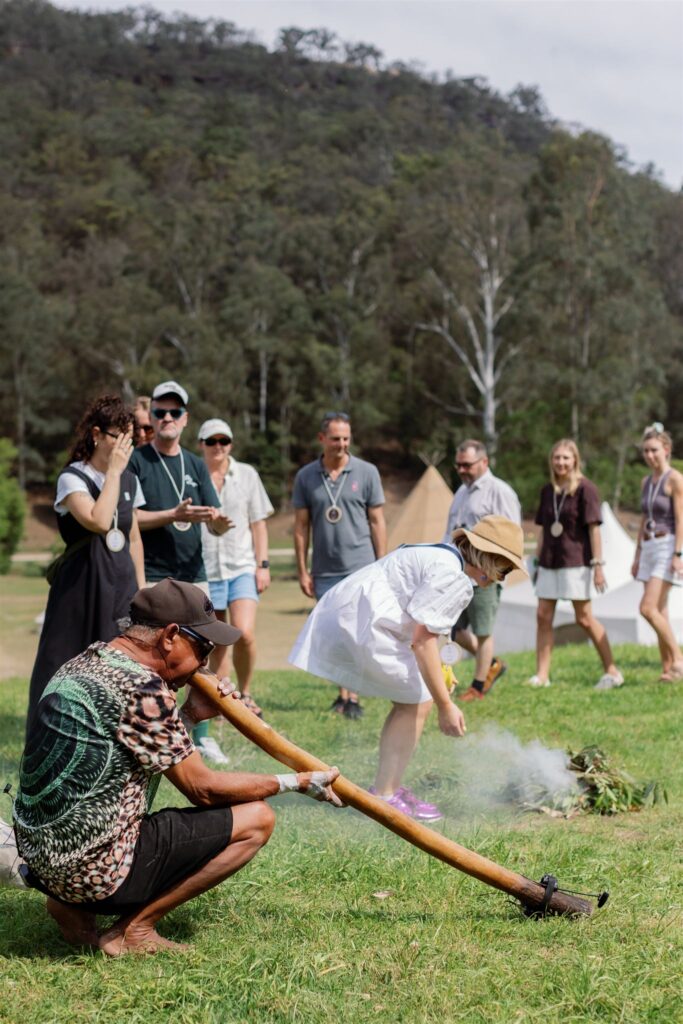
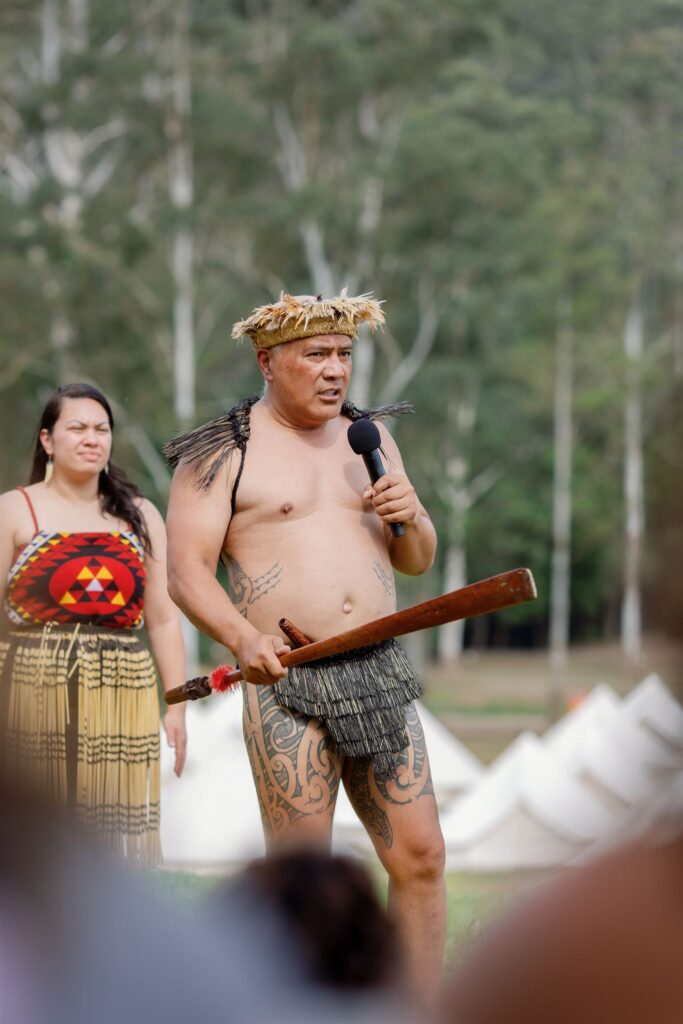
Encircled by trees and surrounded by birdsong, Assembly 2025 began with a moving Welcome to Country and smoking ceremony, grounding us in the spirit, sovereignty and stories. Performed by Darkinjung Elder Uncle Gavi Duncan (Gomeroi, Mandandanji and Awaba), we sunk our toes into lands cared for by First Nations people for tens of thousands of years; land that extends from the Dyarubbin (known commonly as the Hawkesbury River) to the Awaba (Lake Macquarie), and from the sacred mountain of Mount Yengo to the sea.
Next, those who had made the trip across waterways and skies from Aotearoa joined the group with a powerful karanga. Immersing us in song, dance and ceremony, Māori group Te Aranganui performed an impassioned pōwhiri and spine-tingling Kapa Haka, bridging the divide across lands and cultures.
A hard act to follow and armed with iPad, not spear, B Lab AANZ’s own CEO, Andrew Davies, concluded the welcome by reflecting on his own ancestry, and recognising our place as benefactors of stolen land. Setting the tone for the days to come, he offered a Māori whakataukī: “Ka mua, ka muri,” often translated to “walking backwards into the future”. True to the movement’s values of continuous improvement and interdependence, with that, the stage was set.


Images: Elin Bandmann
“What struck me most was the thoughtful integration of First Nations’ wisdom throughout the programming and those present…tangible reminders of how we can build systems that genuinely care for people and planet. [Also] being outdoors, face-to-face, with genuine space to connect (not just crammed panels) is where the real transformation happens.”
— Tom Allen, Impact Boom
Care for the experience
We are in the midst of the biggest evolution in the movement’s near two-decade history, a seismic shift to help us better meet the challenges of our time. As such, we needed to design an experience to energise and stir and challenge, while also bringing clarity and practicality to help us navigate new territories. Enter: experienced creative director and proud Ballardong and Noongar woman, Erica McCalman, and Assembly’s ‘sommelier of sorts’, pairing participants with sessions designed to pique their curiosity and stir their convictions in equal measure.
Envisioned by Erica and the dedicated B Lab AANZ team, and brought to life alongside a crafty crew of local B Corps, attendees were treated to an expansive program of panels, workshops, performances, conversations, and delicious food. In a world that feels increasingly polarised and almost unrecognisable, it was the kind of experience that cracked us open and nudged us back to ‘why’ with a healthy dose of the ‘what’ and ‘how’.
With a mix of big and small B Corps, newly certified and ‘OGs’, there was something for everyone no matter if you were one of the 55+ CEOs or Founders, senior leaders (56%) managers (25%), or part of the cohort of B Consultants.
“Assembly was an inspiring reminder of what makes this movement so special: hope, collaboration, and a shared commitment to building care back into our local and global economies. A gathering unlike any other; we learned, danced, talked governance, connected with old friends, and made plenty of new friends too. An unforgettable experience.“
— Fotini Kypraios, Prisma Legal and Chair of the B Council
Images: Elin Bandmann
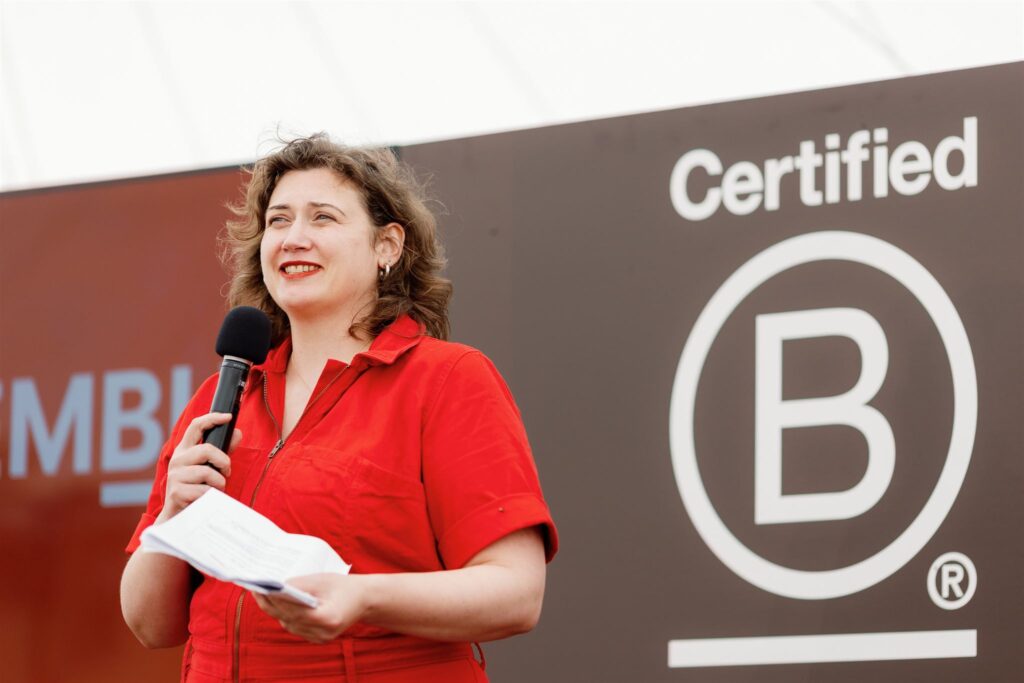
In the lead up, we promised an exciting announcement, and so on the first night, that’s what we delivered. Setting the main Assembly Hall abuzz, B Lab AANZ’s Director of Communications and Engagement, Angie Farrugia, was joined on stage by five members of the North Melbourne Football Club (NMFC).
Stepping into a new league of leadership, this newly Certified B Corporation sets an incredible precedent for the sporting industry and shows what’s possible when an organisation embeds purpose into performance, and uses its platform to drive meaningful change. Not one to miss an opportunity to recruit new members, NMFC President Sonja Hood quipped to the crowd: “If you don’t yet have an AFL team, you do now!”
As evening arrived and fairy lights lit up the valley, First Nations-owned community-based arts company, The Dreaming Project, carved something unique and spectacular into the air. This once-in-forever performance stitched story, culture, and ceremony into the marquee walls themselves, honouring ancestry and bringing Country to life, with artwork projections by artist Judith Franklin and spoken story performance by Uncle Gavi Duncan.


Images: Elin Bandmann
“Assembly 2025 was a whirlwind three days of connection and reconnection with an inspiring community of fellow travellers working to create an economic system that is more inclusive, equitable and regenerative, all to the soundtrack of kookaburras and tents zips.”
— Suzie Hoban, B Consultant
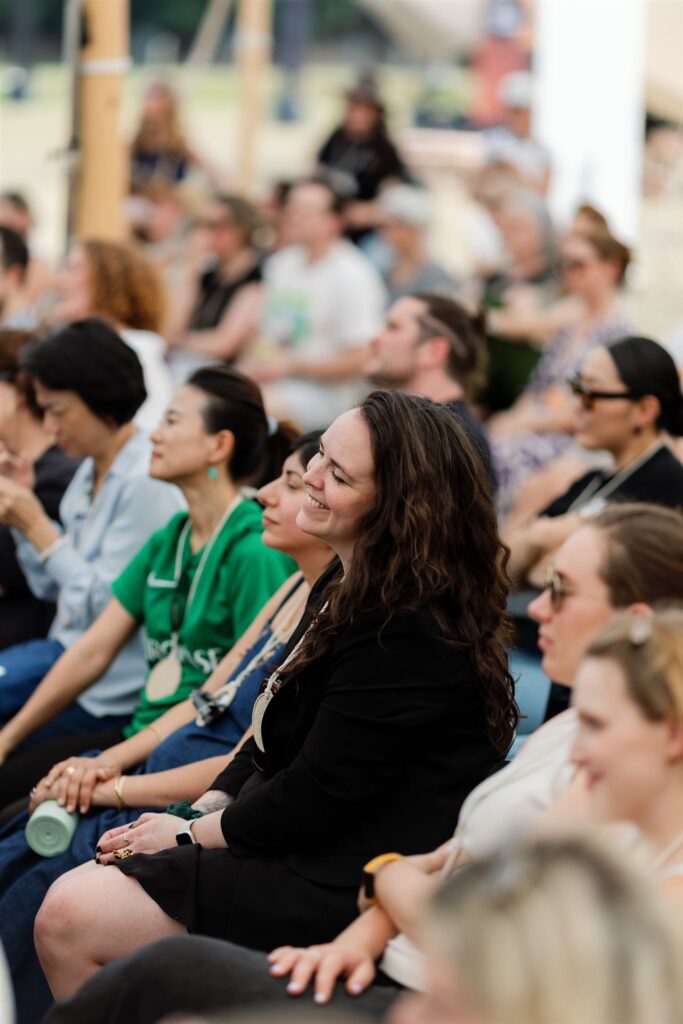
Care for community, and each other
As dawn cracked, the aroma of freshly ground truth filled the air thanks to Pablo & Rusty, while B Lab Global’s Luana Messena and Andreea Pafaluta joined Mindy Leow to offer a clear overview of the new B Lab Standards, and how businesses can co-create the movement’s next chapter.
No topic was off-limits or conversation too curly, as we leaned all the way into the messy, necessary work of reimagining what good business can be. We dug deep into climate action, circularity, and regenerative business; unpacked how to achieve authenticity at scale; and explored everything from virtue signalling and challenging traditional models of leadership rooted in control and hierarchy, to the oxymoron of sustainable fashion.
“There were so many takeaways, but one message that really stayed with me is this: we have an extraordinary opportunity right now to do good for both people and the planet, and it starts by embedding this mindset into our everyday work.”
— Jo Wilson, Modern People
Aptly-named Seed Pods bookended the experience, shifting conversations from concept to connection and creating space for honest reflection in smaller groups. And space between sessions gave us time to digest ideas and yummy food, to wander, reflect, or take a quick dip in the river; a chance to come up for air before diving deep again.
Chatter flowed easily, notes were scribbled on handheld Orbitkey notebooks, and when ambition became almost too heavy to hold, Psychology for a Safe Climate welcomed our tender fears, our grief, and our stubborn hope in dedicated Climate Cafés. Together, these spaces and experiences formed the connective tissue of Assembly 2025: where theory met practice, and where the big talk of better business started to feel within reach.
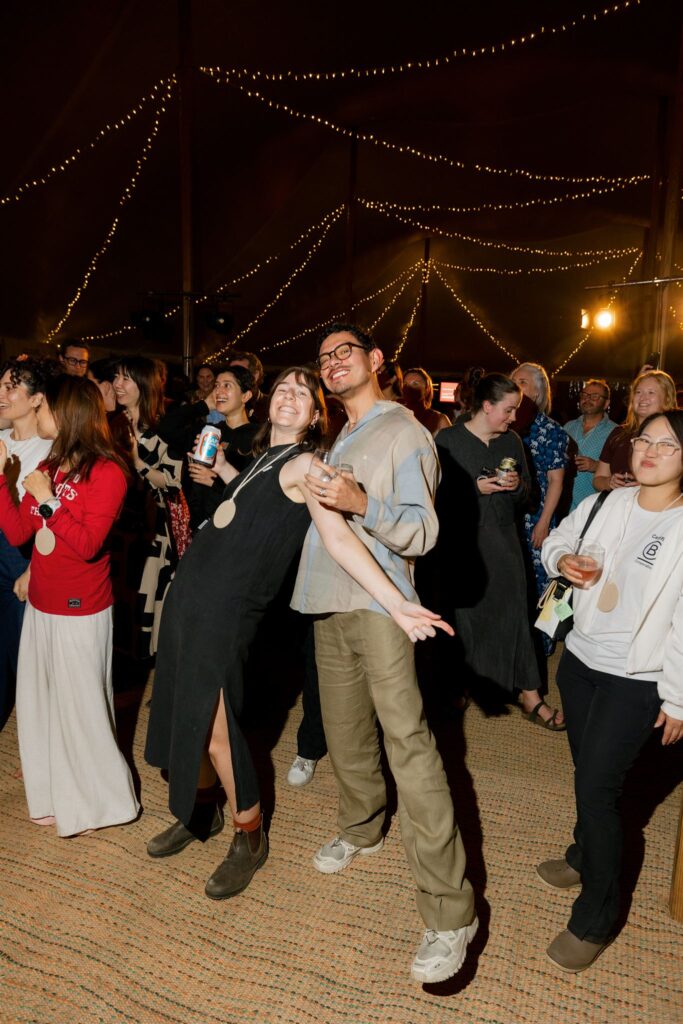
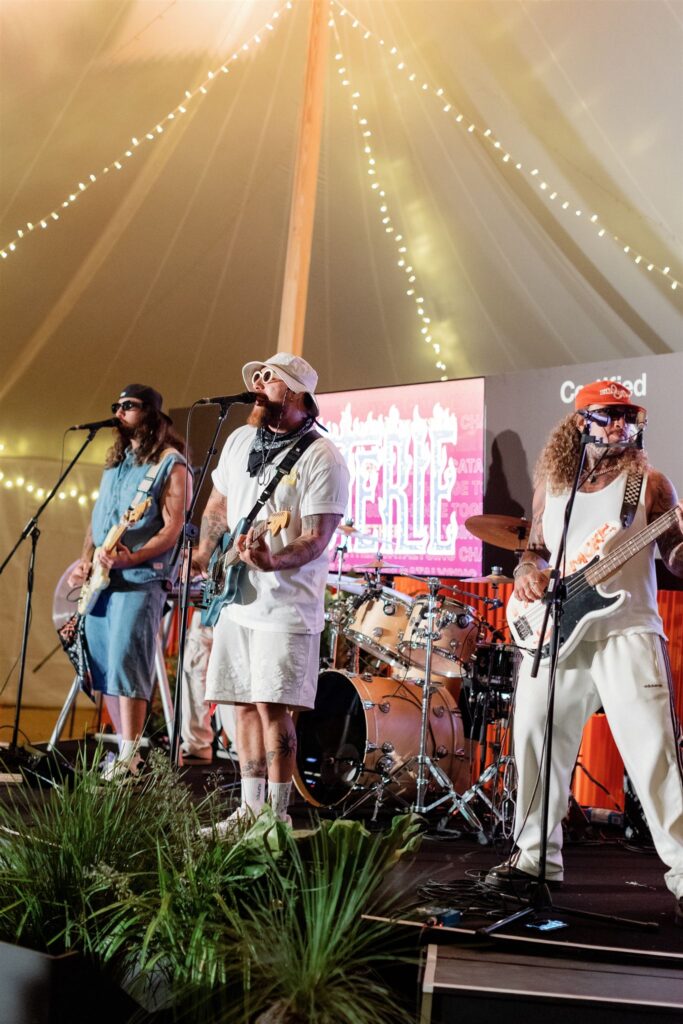
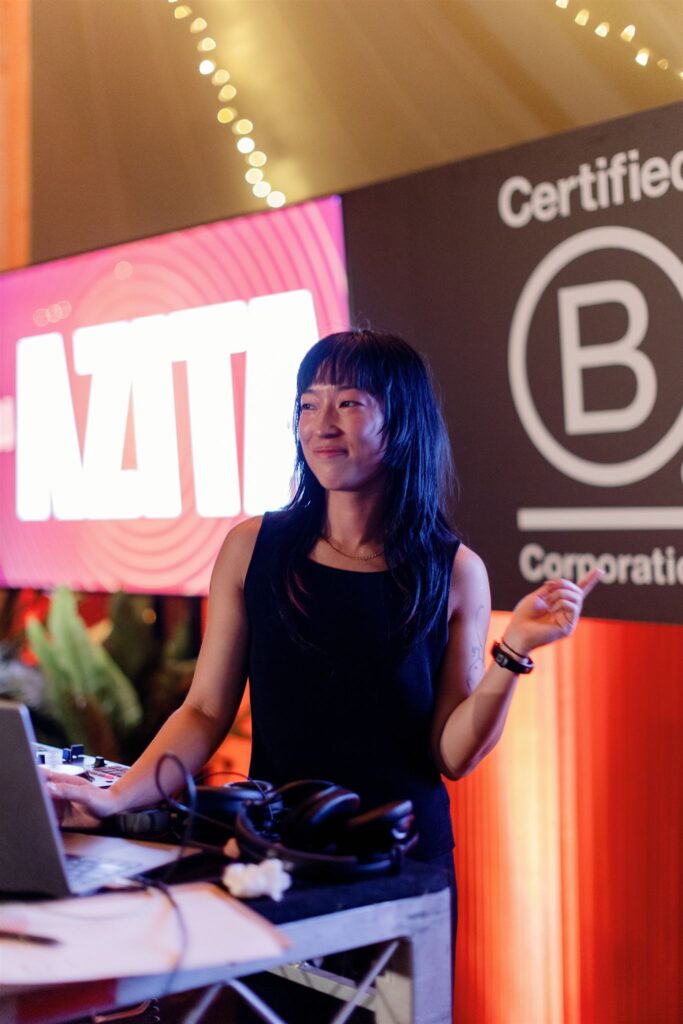
And who could forget Day 2’s climactic end? Moving to the reggae-pop sounds of Te Aupori/Ngāpuhi band of brothers, Coterie, under the stars, followed by B Lab AANZ’s own DJ Azita, spinning the decks and keeping the fire well and truly going long into the night.
Images: Elin Bandmann
“The trip taught me a lot of things. But the most important thing was the necessity of simply being in community with one another, and how good it is for us — as businesses, but as individuals first and foremost. A better, more equitable and more regenerative economy is one that is rooted in community and care — everything else flows outwards from that.”
— Oliver Pelling, Good&Proper
Care for the past that guides us
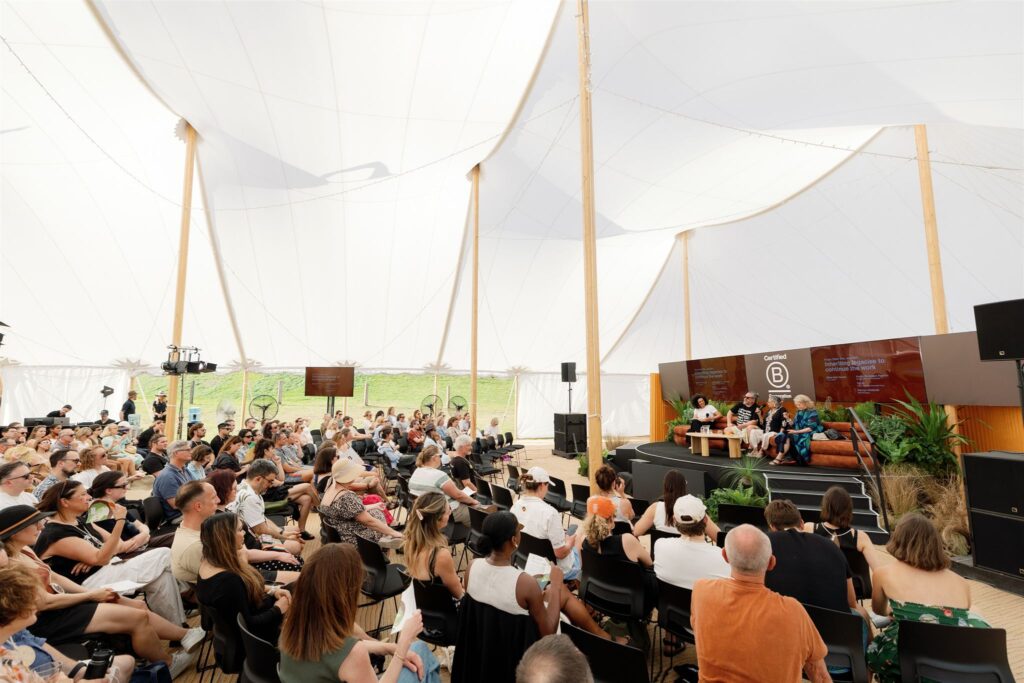
If all of the various parts of the Assembly 2025 program thus far, from fishbowls to film screenings, were its limbs, then what lay at its heart were three exceptional sessions that gathered us all into one shared space.
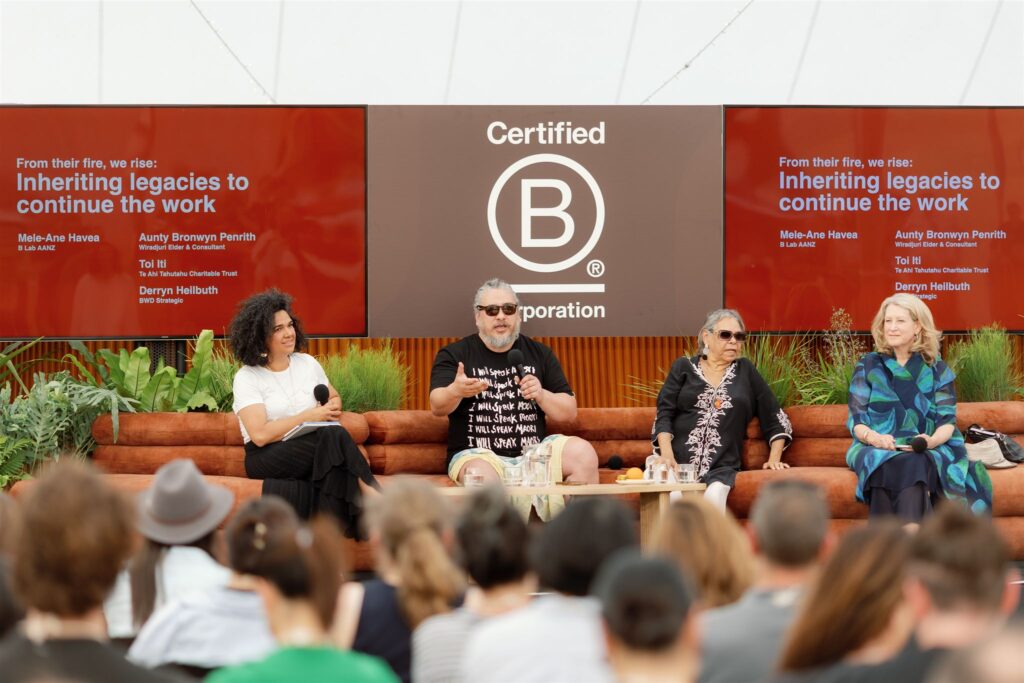
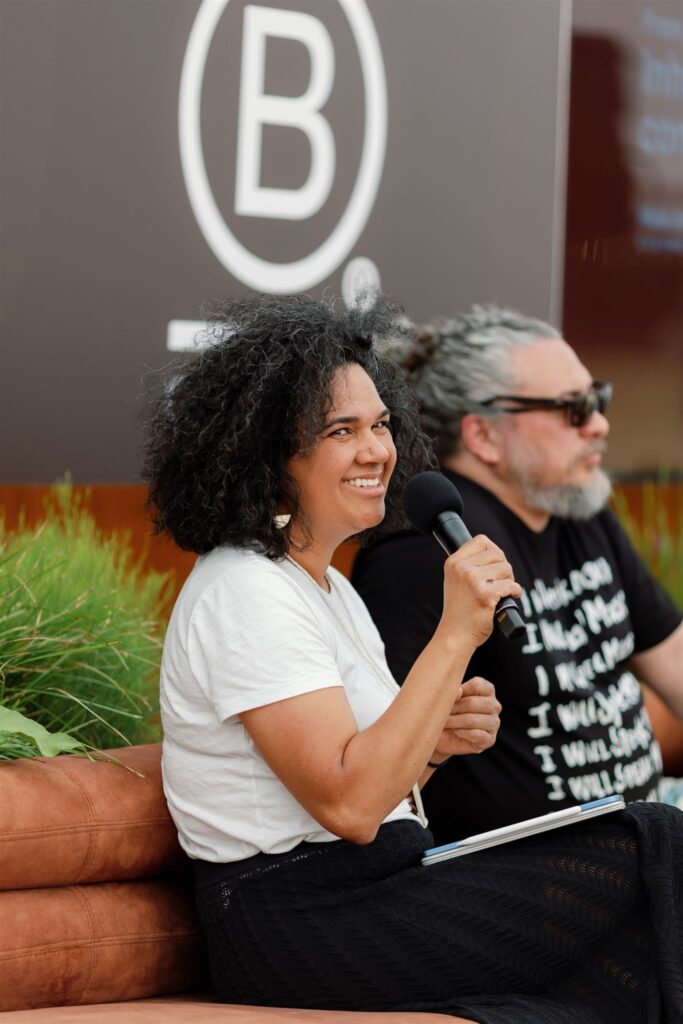
Guided by B Lab AANZ Board Co-Chair Mele-Ane Havea, the first of the ASSEMBLE sessions invited us to reflect on how we can build on the work of those who have gone before. From Their Fire, We Rise welcomed the voices of Toi Iti (Ngāi Tūhoe, Tainui, Te Arawa), Wiradjuri Elder Aunty Bronwyn Penrith, and Derryn Heilbuth, who each stoked us with tales of bold activism, accountability, and the disruptive power of protest.
Images: Elin Bandmann
Exemplifying in real time what it means to embody and extend a legacy by stepping in for his father at late notice, Toi spoke incisively of reclaiming language and identity through art and protest; of putting ego aside and creating space for collective sovereignty to take root.
He recalled how his father, renowned artist and activist Tāme Iti, had been punished for speaking Māori at school, forced to write ‘I will not speak Māori’ on the board. “So we flipped it,” Toi shared. “We turned it into merch, ‘I will speak Māori,’ recontextualising the mahi, the work, and putting it in a way that makes people think.” His message for the movement was clear:
“Stay woke. Stay conscious. Organise. Be political. Because business is political. Clothing is political. Where you source things is political, all those choices that you have the power to make. It’s rough out there. Don’t be fair-weather friends to Indigenous peoples.”
— Toi Iti (Ngāi Tūhoe, Tainui, Te Arawa)
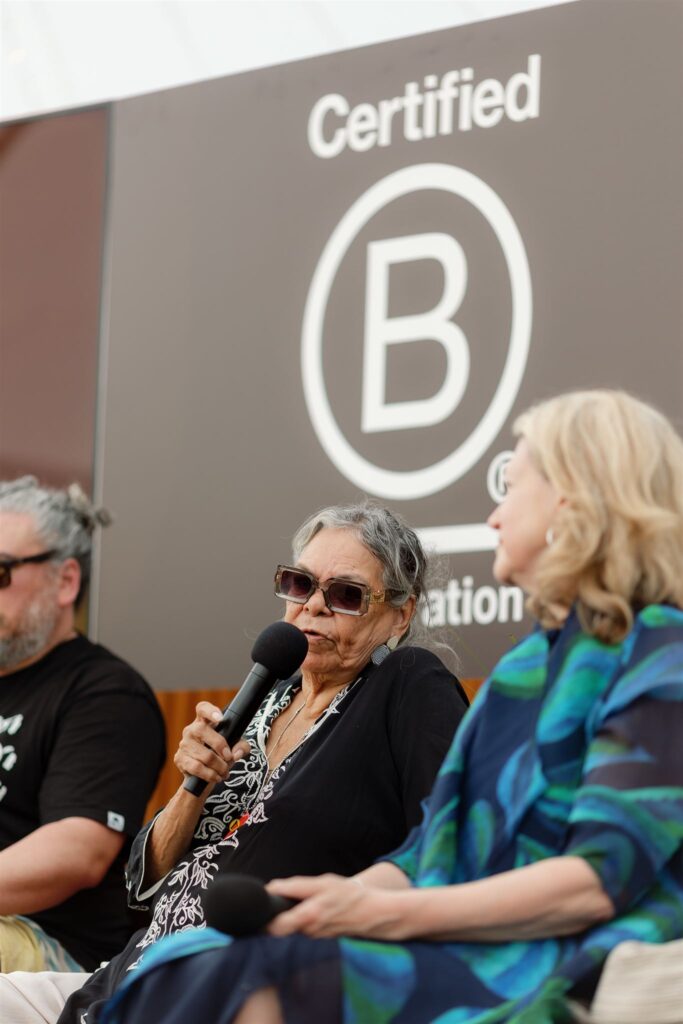
Aunty Bronwyn Penrith (Wiradjuri) shared her recollections from the early days of the Aboriginal Tent Embassy to the stages of the National Black Theatre, established in 1972 in response to the emerging land rights movement in Redfern. “In my eyes I still think I’m an activist,” she remarked before urging us that, despite some material progress, we still have a long way to go. Imploring us to remember that compliance alone cannot deliver change, Aunty Bronwyn shared:
“Direct action wasn’t such a bad idea, it’s effective. We need to come together now. Fight on. Be proud of who you are. There’s still a long way to go, but there’s a role for you in that, in how you treat Aboriginal people.”
— Aunty Bronwyn Penrith, Wiradjuri Elder
Images: Elin Bandmann
Rounding out the panel was Derryn Heilbuth (BWD Strategic), who started her career as a journalist in apartheid South Africa and whose “roots cover continents, generations, and turbulent moments in history”. Covering the struggles of the early feminists and Black Student uprisings, to joining a human rights and social justice organisation called the Black Sash, Derryn imparted:
“From those really important years… there [have been] three, sort of, major lessons. The first is that ordinary people can really make a difference. The second is never to be afraid to speak truth to power. And the third is that we can do extraordinary things when we collaborate and connect across sectors, cultures and disciplines.”
— Derryn Heilbuth, BWD Strategic
Part ancestral directive, part reckoning, the first ASSEMBLE session served as a living archive of resistance, imploring us to care for and reignite the work of those who came before, not as nostalgia, but to light the way forward. For it is only from the shoulders of these giants that we can glimpse the future.
Images: Elin Bandmann
Care for the shared future that stretches in front of us
On the morning of Day 2, Tamsin Jones from Small Giants Academy introduced two young leaders at the forefront of the climate crisis in Clear eyes, hearts forward.
Ruby Rodgers and Tishiko King (Kulkagai) stood before a sea of adults, and challenged us to put our differences aside for the sake of our shared future. The kind of young people who make you feel not only is the future in good hands, but the here and now too, they spoke with heart and urgency about the kind of future they are determined to build.
Reflecting on her experience attending protests from a young age and having honest conversations with her parents about the state of the world, Ruby shared how they prepared her, rather than scared her:
“A lot of people are very scared right now. We can see that there is something incredibly wrong. [But] I didn’t lose hope when I found out about these things, it actually made me want to do something, do more. And so I think it’s really, really important to have these conversations with the kids or young people in your life, to not shy away from these conversations. Because who knows what they will do, they could create so much change.”
— Ruby Rodgers, Future Council

Images: Elin Bandmann
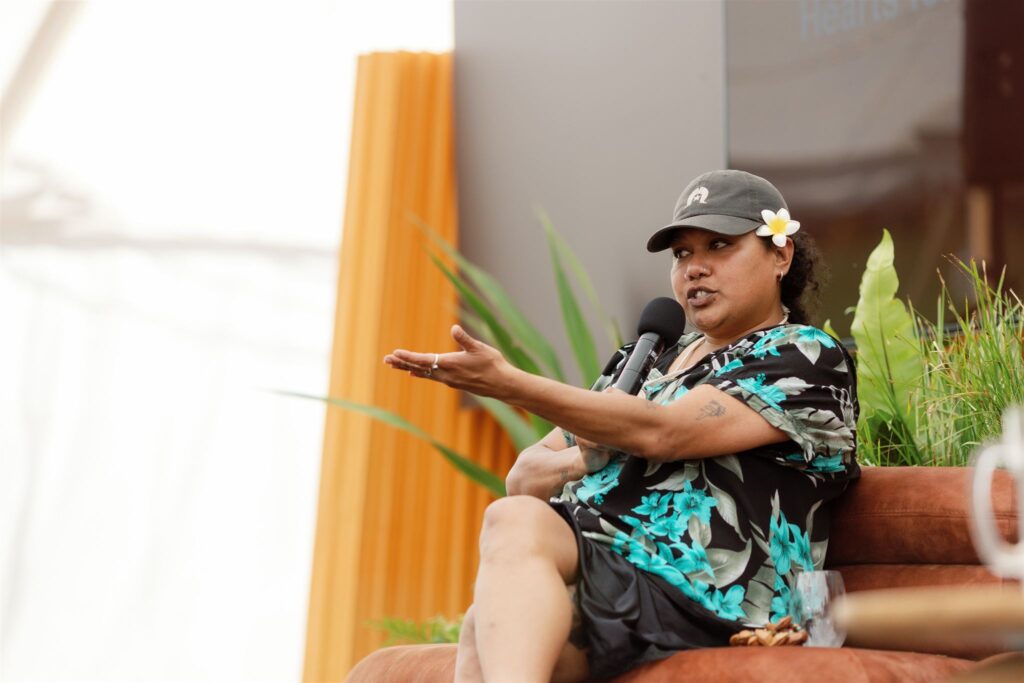
Founder of Just Futures Collab and proud Kulkalaig Salt Water woman from the island of Masig in the Torres Strait (Zenadh Kes), ‘Tish like fish’ spoke of the realities being on the frontlines of the climate crisis; of coastal erosion ripping away lands and king tides washing away burial sites. From being birthed on a coconut mat to launching an Aboriginal and Torres Strait Island-led giving circle, Tish shared a compassionate reminder to “say hi to everyone” and that “it’s okay to cry; this work is tough sometimes”.
“I started this fight when I was your age, [Ruby]. I’m now ‘youth adjacent’. But I think it really goes to the responsibility of what we’re actually inheriting today…what are the choices that you are making today for a better tomorrow? How can we learn the lessons from our old people, the wisdom holders, the knowledge holders from yesterday, to guide us through?”
— Tish King, Just Futures Collab
Images: Elin Bandmann
Before taking the stage again alongside her father Ben to close the session, Ruby extended a hand across generations, imploring us to amplify the power of the ripple effect, and to always find “the hope and the storytelling and the joy in everything you do”. Together, they reminded us that care for the future isn’t abstract, it’s here, standing on stage, asking us to act like it matters.
“There were few dry eyes in the house when 16-year-old Ruby Rodgers took to the stage to inspire attendees through what she has already achieved, and to perform an original single and Coldplay’s Fix You.”
Care for the movement that rallies us
“In many First Nations cultures, when a leader passes, they become an ancestor. B Lab has lost its first leader, but it has gained its first ancestor,” shared Erica McCalman. That ancestor was Andrew Kassoy, B Lab’s co-founder, who passed away in July 2025.
In a hauntingly powerful video beamed across the main tent, Kassoy reflected on his ambition for the B Corp movement from palliative care, alongside co-founders Bart Houlahan and Jay Coen Gilbert. The intention, as he puts it, was never to build an ‘army of B Corps’. The aim was, and is, to catalyse and enable a movement of sufficient breadth and power to influence change across an entire economic system; a community that cares about each other, and looks out for each other and the planet.
“I think one of the things that makes capitalism not work as a system [is that] it was built on the idea of carelessness. And I think that, you know, the experience of being sick, but mostly the experience of being part of this community, has been such a stark opposite to that…The idea of care, as the opposite of carelessness, [has been] built into the institution and standards themselves. Like you’re not just here to do good, you’re here to care.”
— Andrew Kassoy, B Lab co-founder
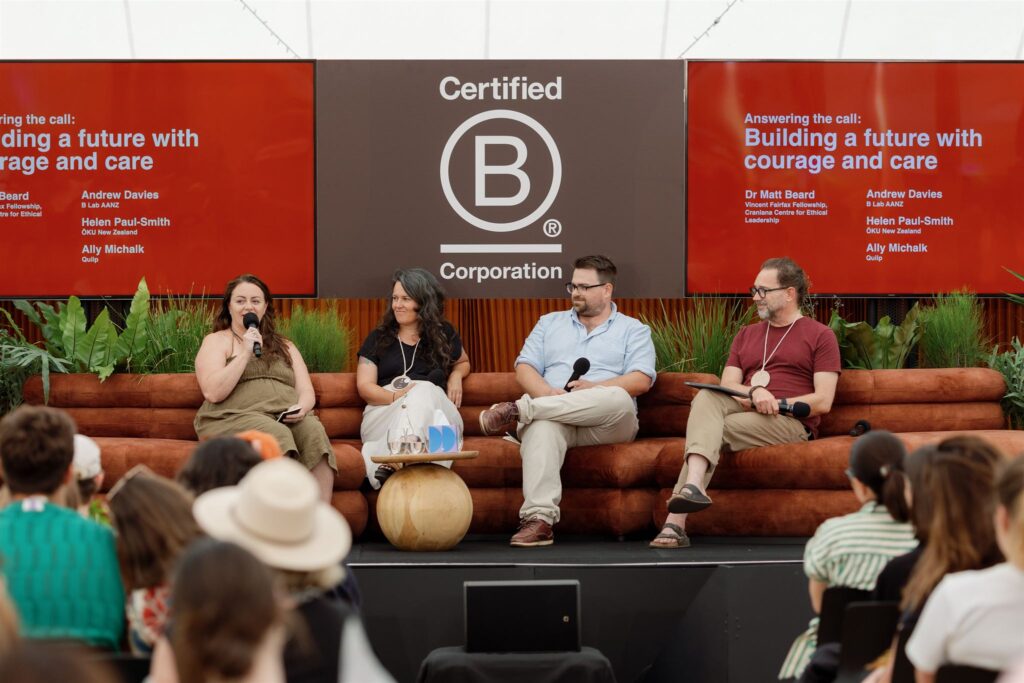
This idea that care must be built into any system that seeks to do good were some of Kassoy’s last words, and the through-line for the final of our ASSEMBLE sessions — a conversation on the architecture and currency of care.
Philosopher and ethicist Dr Matt Beard explored the difference between caring for and caring about. “When you care for something, it’s about meeting the needs of the other,” he explained. It’s relational, you are dispensing with something that meets their needs, and therefore you have to be connected to them.
On the other hand, caring about something means “you are invested, personally, morally or emotionally, in that other person getting their needs met”. As such, it’s more distant, decontextualised; not bad, just different. When it comes to the carelessness of capitalism, the danger, Dr Beard warned, is outsourcing responsibility for ‘caring’ to the system itself, rather than realising that it’s also our work to do, as individuals and as a community, in relationship with each other:
“I think one of the challenges when we think about care in the context of capitalism is that we’ve indexed pretty heavily on caring about things. We have very loud and prominent views that we express about all kinds of things that are going on. And so when I think about systems of care, the first question I ask is: well, which is it? Is it systems that care about things, or is it systems that care for things?”
— Dr Matt Beard, Cranlana Centre for Ethical Leadership
ŌKU co-founder, Helen Paul-Smith (Tapuika and Ngāi Te Rangi), grounded those ideas in practice, sharing how the Te Ao Māori worldview already holds the blueprint for a regenerative economy. “When I put our kaupapa, our purpose, out there,” she said, “I’m saying to my ancestors and to future generations that we will do more for Papatūānuku, our Earth Mother, than we take from her.”
Measuring success against a quadruple bottom line (cultural, environmental, social, financial), every decision must honour that lineage and be accountable to a whole system; of whānau (family), the environment, mountains, rivers, ancestors, and future generations.
Images: Elin Bandmann
Cutting through complexity with laser-sharp insights, Alison Michalk (Quiip) added that, “no matter the spaces that I travel through, the things I read, the videos I watch, it all comes back to community,” reassuring us that community is the solution to all our problems.
“If we look at what drives people to participate in communities, it’s our behaviours that we have every day. It’s looking for a sense of connection. It’s looking for a sense of belonging. It’s [wanting] to feel like we have an impact on our surrounds. All of these things are what’s driven everyone here today. [But] sometimes we forget to ask not what we get from the B Corp movement, but what we contribute.”
— Alison Michalk, Quiip
Perhaps, as Andrew Davies noted in closing, the best way we can build an economy of care is simply by caring for someone or something. “It sticks with me that the idea of caring for something is deeply human, but can feel very much not like we’re achieving change,” he pondered.
For a movement with the lofty goal of ‘fixing capitalism’, that might feel counter-intuitive; not focusing on the system itself, but directing our attention to the ways in which we show up and care for our fellow travellers, normalising discomfort and disagreement along the way.
Indeed, if systems change happens relationally, as a movement, we have to ask ourselves whether the goal is to create a system that cares (i.e. a caring system as the end goal), or is care the means by which we change the system?
“Those fighting progress will always resist, we know resistance is inevitable and that change always starts with ourselves. I don’t know what will happen in a world that seems harder than ever to predict, and where progress feels elusive. But I know navigating change is always best done in good company, and you are all the best people to walk alongside.”
– Andrew Davies, B Lab AANZ CEO
Care for the moment, as we raise the bar even higher
This was the story of Assembly 2025. A moment in time for a movement ever-evolving, and doggedly reorienting the economy one dollar, and one business, at a time. However, the energy and connections sparked on Darkinjung Country were never meant to stay contained, they were meant to travel with us. To spur us on and guide our actions through the choices yet to come.
It must be said that an experience of this magnitude is near impossible to distill in words alone. Thankfully, we also have the sublime videography of Laundry Lane (watch here for Day 1, Day 2, Day 3, and below for the full wrap) and the stunning photography of Elin Bandmann to timestamp the experience, as well as the insights and reflections from many across social media.
An event of this magnitude and ambition takes a village to pull together. With gratitude and thanks to Erica McCalman, and the wider B Lab Australia and Aotearoa team for making this gathering so special.
Thank you to our global B Lab colleagues for joining us, the entire Glenworth Valley team, as well as the many event partners and in-kind supporters for co-creating such a memorable three days. It simply would not have been possible without you.
We also honour and appreciate those who were not able to join us this time but who contribute such care, passion and energy to the movement from across our region, and the globe.
Images: Elin Bandmann
Above all, Assembly 2025 reminded us that real progress won’t come from tinkering around the edges. Change worth making is usually messy. It’s relational. And it requires us to keep swatting away those flies with our eyes on the prize: a more equitable, inclusive, regenerative economy that truly benefits all.
B Corps, this is our moment — urgent, vital, and full of possibility. The systems we’ve inherited weren’t built for care, but we are. Here’s to showing up, imperfectly, bravely, and together, with care as both our compass and our path.
| Thank you to our event partners: AV1, Small Giants Academy, Australian Ethical, Frank Wild, Good & Proper, Laundry Lane, Paper Moose, Radish Events, Look Brilliant, Zea, 4 Pines, Beyond Bank, Carbon Creative, Cultivating Leadership, Nation Partners, Teachers Mutual Bank Limited, The Commons, Yellow Edge, Orbitkey, Intrepid Travel, and Edge Impact. Thank you to our in-kind event supporters: Pablo & Rusty’s, Valiant, Who Gives A Crap, Ecostore, Australian Vintage, Lion, Thankyou Group, Vitasoy, Market Lane Coffee, Emma & Tom’s, Heaps Normal, Almighty Drinks, LUMIRA, Goodbye, ŌKU and Two Islands. |
Words by Carmen Hawker (CARMEN GET IT!)
Images by Elin Bandmann
Videos by Laundry Lane
Want to be the first to hear about future B Lab AANZ events?
Sign up to our newsletter and join a B Local near you ↗
Looking for your next read?
See how Assembly 2025 evolved from its previous incarnation: Assembly 2024: A story of courage, convergence and community ↗

